
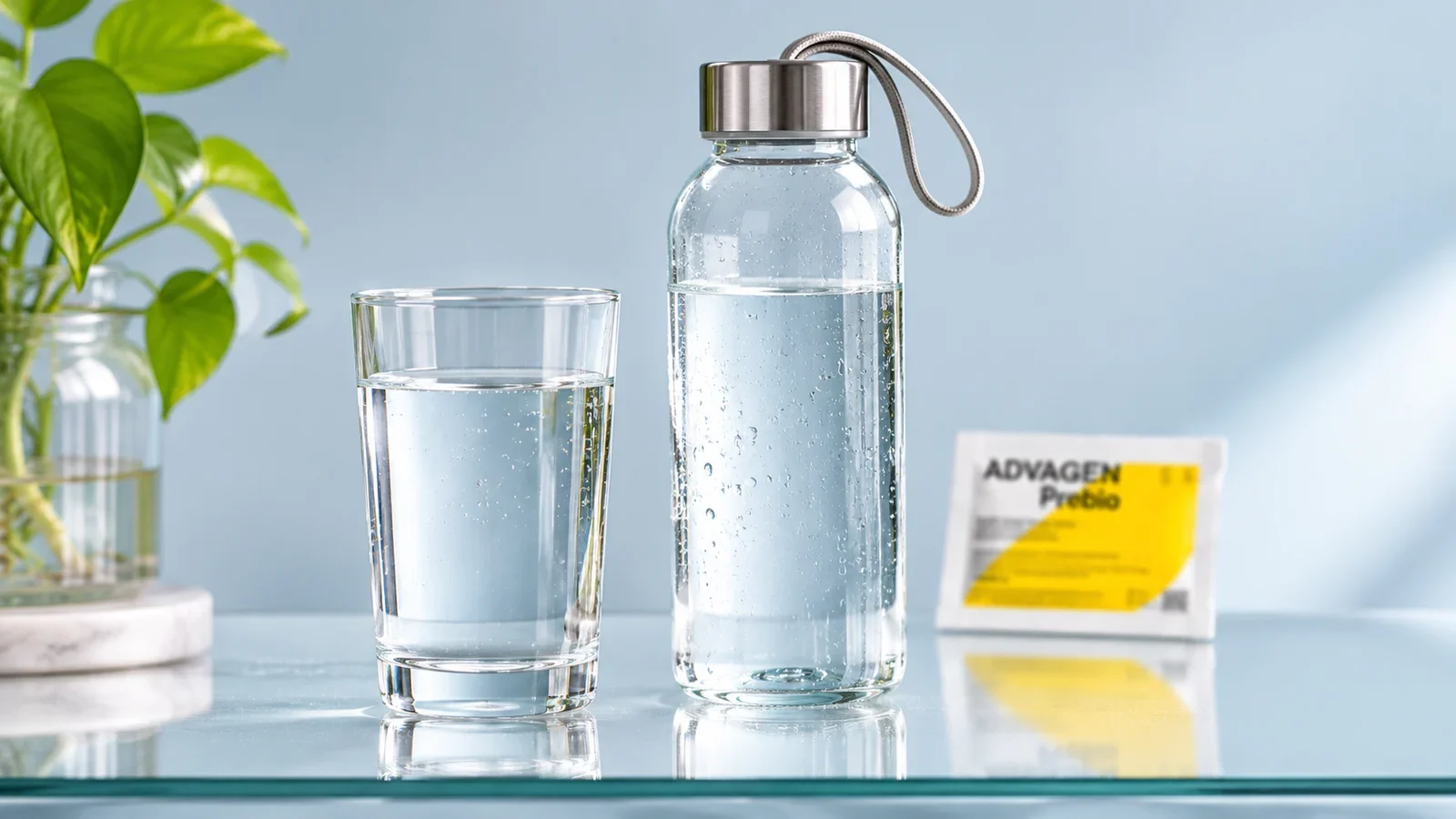
You started a fiber supplement to feel more regular, and now your tummy feels tighter than before. Or every sachet comes with a big glass you must finish on the spot, so some days you skip it. Here’s the short answer on how much water to drink with a fiber supplement: HealthHub’s daily guide is six to eight cups of fluid or more. Any extra glass at the time depends on the fiber you use.
Key takeaways
- Your daily fluid target comes from HealthHub, not the sachet. Drink more when it’s hot or you’ve been sweating.
- Gel-forming husk fibers come with a “full glass, drink it now” rule, because they swell.
- A fiber that doesn’t gel, like ADVAGEN Prebio, just goes into the drink you’re already having.
- Add fiber slowly over 2 to 3 weeks. If your doctor limits your fluids, follow your doctor.
Why extra fiber can backfire when you don’t drink enough
Fiber and water work as a pair. SingHealth explains that “fibre absorbs water in the intestines, which softens stools”. Without enough fluid, that job gets harder. HealthHub’s advice for anyone eating more fiber is to “remember to drink more water, otherwise your constipation might become worse”.
Speed matters too. SingHealth says a sudden increase of fiber can cause bloatedness from extra gas. Raising your intake slowly over 2 to 3 weeks keeps this down.
Combine a big jump in fiber with too little to drink, and it’s easy to see why people try a supplement for a week, feel worse and give up. The fix is steady fluid through the day, a slow start and a fiber that fits your routine.
How much water to drink with a fiber supplement each day
The daily total is the number that counts. HealthHub’s advice is to drink “at least six to eight cups of fluid or water a day”, alongside about 25 to 30 g of fiber. The NHS gives the same range: “6 to 8 cups or glasses of fluid a day”. It advises more if you’re in a hot environment, active for long periods, pregnant or breastfeeding, or unwell.
If you prefer litres, Europe’s food safety authority, EFSA, considers 2.0 litres a day adequate for women; for men, the figure is 2.5 litres.
You may have read online that every fiber supplement needs a set amount of extra water on top of this. HealthHub, the NHS and EFSA give no such figure, so set it aside. Meet your daily target first, then follow the directions for your fiber. The NHS adds a simple check: drink enough that your pee is a clear pale yellow colour.
Why husk-type fibers come with a full-glass rule
Some fiber supplements are made from husk (ispaghula, also called psyllium). MedlinePlus, from the US National Library of Medicine, says the husk “absorbs liquid in the intestines, swells, and forms a bulky stool”. Because it swells, the directions are strict about water at the time you take it:
- HealthHub’s medication leaflet says to stir each sachet into a glass of room temperature water (about 150 ml) and drink it immediately, after meals, and not right before bed.
- MedlinePlus says you must drink at least 240 ml of liquid each time you take psyllium.
- The NHS leaflet for an ispaghula husk sachet adds that “adults should try to drink more than 2 litres, or around 8 glasses, of fluid each day” while taking it.
None of this makes husk a bad choice. If your doctor or pharmacist recommends it, take it exactly as the leaflet says.
But the NHS leaflet’s usual adult dose is one sachet twice a day. If you just want to top up your daily fiber, a twice-daily “mix it, drink it now, finish the glass” ritual is the part that slips first. HealthHub also notes husk may cause wind or bloating in the first few days.
| Gel-forming husk (ispaghula / psyllium) | ADVAGEN Prebio (resistant dextrin) | |
|---|---|---|
| Water when you take it | A glass of about 150 ml (HealthHub) or at least 240 ml (MedlinePlus), drunk straight away | Stir into your drink of choice until dissolved (ADVAGEN label directions) |
| Texture | Absorbs liquid and swells | Soluble, does not form a gel, no change to taste or texture |
| Daily fluids | NHS leaflet: more than 2 litres, around 8 glasses | Your normal daily target still applies (HealthHub: six to eight cups or more) |
The easier option: a fiber supplement that does not gel
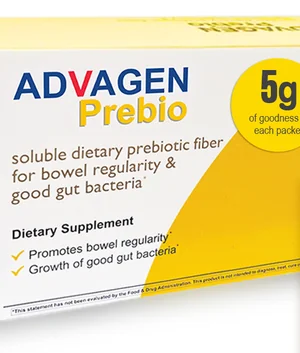
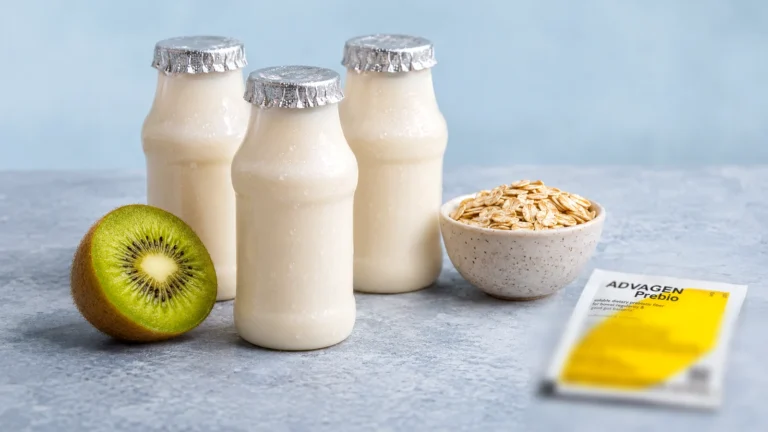
This is where ADVAGEN Prebio makes life simpler. It’s resistant dextrin, a plant-based soluble fiber sourced from corn. According to its product page, it doesn’t form a gel, doesn’t change the taste or texture of your food or drink, and dissolves and mixes in an instant. The label says to add a sachet to your drink of choice and stir until dissolved, or mix it into your food.
So there’s no separate glass to finish in one go. You use the cup you were having anyway. In ADVAGEN’s own explanation, its “water binding capacity draws water to the stools, softening them”. That’s why your daily fluids still matter, even with a fiber that doesn’t gel.
ADVAGEN Prebio: daily fiber without the big-glass routine
One sachet gives you 5 g of dietary fiber. ADVAGEN makes it to “promote bowel regularity and the growth of good gut bacteria”. 30 sachets a box, SGD 29.60 in the official ADVAGEN shop (price checked 3 November 2026).
- Get ADVAGEN Prebio in the official shop
- Ask us on WhatsApp if you’d like help first
Your daily water and fiber routine in Singapore’s heat
On hot days, or after you’ve been sweating, the NHS says you may need more fluids than usual. Here’s a simple routine for a Singapore day:
- Start low with fiber. The Prebio label allows 1 to 4 sachets a day for adults. Begin with one sachet in your morning drink. Add more slowly over 2 to 3 weeks, as SingHealth advises for any rise in fiber.
- Keep water within reach. A bottle on your desk or in your bag helps you drink regularly through the day, as the NHS suggests, instead of catching up at night.
- Count every drink. Tea and coffee count too. So do lower-fat milk and lower-sugar drinks, according to the NHS.
- Top up after you sweat. After a walk in the midday sun, a gym session or a long commute, drink extra water to replace the fluid you lose, as the NHS recommends.
- Check the colour. Clear pale yellow is the NHS’s simple sign that you’re drinking enough.
- Keep food in the picture. Vegetables, fruit and wholegrains still come first. SingHealth puts the average Singaporean at about 13 g of fiber a day, well short of HealthHub’s 25 to 30 g. A 5 g sachet is a top-up, not a replacement for meals.
Not sure which fiber suits you? Our guide to psyllium vs inulin vs resistant dextrin compares them, and what fiber is good for constipation explains which types have the most evidence.
When general water advice is not for you
If your doctor has told you to limit fluids, for example because of a heart or kidney condition, follow your doctor, not the figures in this article. For heart failure, HealthHub’s advice is to keep fluids at “not more than 1.5 litres a day or as instructed by your doctor”. That limit includes coffee, tea, soup, porridge and the water you take with medicines. Ask your doctor or pharmacist before adding any fiber supplement.
Do the same if you’re pregnant, take regular medicines or manage a health condition. For children under 6, ADVAGEN’s label says to ask your paediatrician first. If you’re caring for an older parent who doesn’t drink much, our guide on fiber for elderly parents has more ideas.
“Won’t I still have to drink a lot?”
Honestly, yes: about as much as you should drink anyway. Prebio doesn’t change your daily fluid target. It removes the extra glass you have to finish on the spot.
You may notice a little more gas in the first days: ADVAGEN explains that the fiber is fermented in the large intestine, and this produces gas. So start with one sachet and build up slowly.
If that’s a routine you can keep, get ADVAGEN Prebio in the official shop, where you’ll find the full label and directions. Got a question about your own routine? Message us on WhatsApp (+65 8652 6228) and we’ll get back to you.
FAQ
Do you need to drink water with a fiber supplement every time?
It depends on the fiber. For gel-forming husk, HealthHub’s leaflet says about 150 ml of water per sachet, drunk straight away, and MedlinePlus says at least 240 ml for psyllium. ADVAGEN Prebio doesn’t form a gel; its label simply says to stir it into your drink of choice until dissolved. With either type, keep up your daily fluids.
What’s my total water target when I take fiber?
Aim for HealthHub’s six to eight cups of fluid a day or more. If you count in litres, EFSA’s figures are 2.0 litres (women) or 2.5 litres (men). Drink more on hot or active days, as the NHS advises. On husk, the NHS leaflet asks for more than 2 litres a day. On Prebio, your normal daily target still applies; the label gives no set amount of water, just your drink of choice.
Why does starting fiber make me feel more bloated?
Usually because the fiber went up too fast. SingHealth says a sudden increase of fiber can cause bloatedness from extra gas, and suggests increasing it slowly over 2 to 3 weeks. If the bloating is strong or doesn’t settle, see our guide on feeling bloated without eating much and speak to a doctor.
Do coffee and tea count towards my daily fluids?
Yes. The NHS counts tea and coffee towards your daily fluids, along with water, milk that’s lower in fat and drinks that are lower in sugar. It also advises having caffeine in moderation, so keep plain water in your day too, especially after sweating. For Prebio, the label simply says to stir a sachet into your drink of choice until dissolved.
When should I take a fiber supplement if I’m on medicines?
Ask your pharmacist, because it depends on the medicine and the fiber. For ispaghula husk, the NHS leaflet says to take it at least 30 minutes before or after any other medicine. ADVAGEN’s directions for Prebio don’t set a timing rule. If your stools change a lot, our guide to how often you should poop shows what’s normal.
References
- HealthHub: constipation
- HealthHub: ispaghula husk medication leaflet
- HealthHub: monitoring fluid and salt intake with a heart condition
- SingHealth: high fibre diet
- NHS: water, drinks and hydration
- NHS: how and when to take ispaghula husk
- NHS: constipation
- EFSA: dietary reference values for water
- MedlinePlus: psyllium
- ADVAGEN Prebio: product page and label
This article is general information, not medical advice. ADVAGEN Prebio is a dietary fiber supplement and is not intended to diagnose, treat, cure or prevent any disease. Speak to a doctor or pharmacist about your own health.
Share this article:





[…] of six to eight cups of fluid a day. Keeping a bottle on your desk makes that easier. Our guide on how much water to drink with fiber goes into […]
[…] gas, bloating or constipation, so start small and build up. Drink enough water as well; our page on water with a fiber supplement covers the drinking […]