
What Fiber Is Good for Constipation? Types, Water and Tips
What fiber is good for constipation? The fiber with the strongest evidence is a soluble, gel-forming fiber such as psyllium. In a review of 16 trials, it worked best at more than 10 g a day, taken for at least four weeks. Drink enough with it. Add fiber slowly over two to three weeks, because more is not always better.
If you have already tried “more fiber and lots of water” and nothing changed, you are not alone. One person on a constipation forum wrote, “high fiber with lots of water, and a few other diets. Nothing has really helped at all.” That is frustrating. But there is often a simple reason. Which fiber you choose matters. So does how much you take, how long you give it and how much you drink.
Here is the short plan. Choose a fiber with good evidence behind it. Add it slowly. Drink enough with it. Give it about four weeks. And see a doctor if any warning sign appears. Each step is explained below.
Soluble or insoluble: which fiber helps?
Both types can help, but in different ways. Soluble fiber soaks up water as it moves through the gut. That helps make stools softer and easier to pass. Insoluble fiber does not absorb water. It adds size and bulk to stools instead. That is how the Health Promotion Board’s HealthHub describes the two types.
Singapore General Hospital’s high-fiber diet page says much the same. In the gut, fiber draws in water. That makes stools bulkier and softer. So water is part of how fiber works. It is not an optional extra.
For hard, dry stools, a soluble fiber that holds water is usually the better place to start. Insoluble fiber from wholegrains, bran, nuts and fruit skins still belongs in a balanced diet. One catch: “soluble” covers many different fibers, and they do not all behave the same. If you want the basics of each type first, read our guide to soluble and insoluble fiber compared.
Which fibers people use, and which have the best evidence
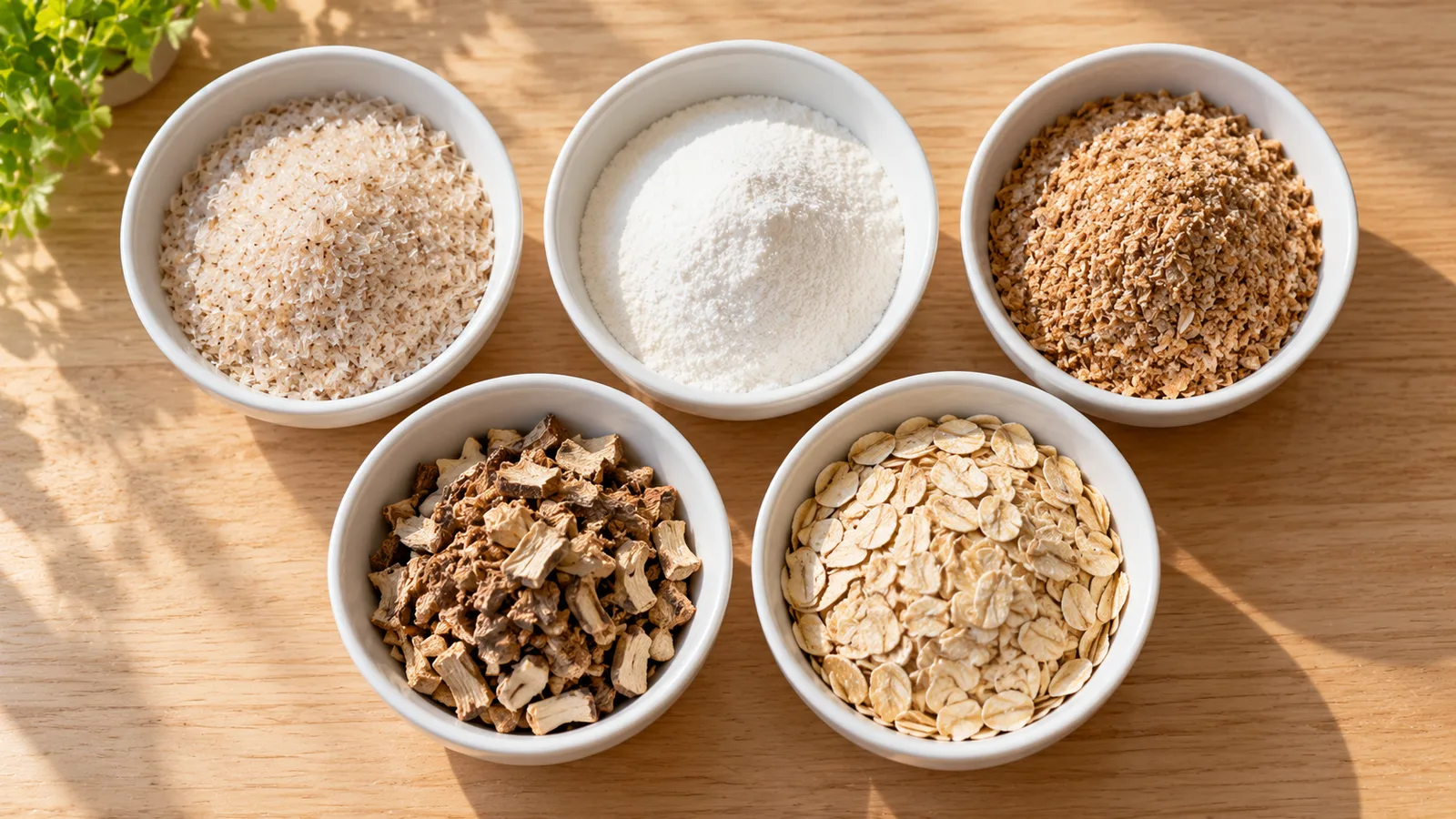
Researchers have tested many fibers for constipation. The list includes psyllium (also called ispaghula), inulin and oligofructose, wheat bran, polydextrose, galacto-oligosaccharides and guar gum. Others have tested whole foods instead, such as prunes, kiwifruit, rye bread and oats.
A useful summary is a 2022 review from King’s College London. It pooled 16 randomised trials with 1,251 adults who had chronic constipation (van der Schoot et al., 2022). Overall, 66% of people taking fiber responded, against 41% in the comparison groups. Psyllium and pectin were the fibers that showed clear effects. The benefit showed up mainly at doses above 10 g a day, and after at least four weeks.
So “any fiber” is not the same as “a fiber with evidence”. If a fiber product does not seem to help after a few days, there are three likely reasons. It may be the wrong fiber. The dose may be too small. Or you may not have given it long enough.
In 2023, the American Gastroenterological Association and the American College of Gastroenterology issued a joint guideline on chronic constipation. It gives fiber a conditional recommendation. Some osmotic laxatives, such as polyethylene glycol, get a strong one (Chang et al., 2023). Fiber is a sensible first step for many people. It is not always the last one.
Why water matters
Fiber softens stools by holding water. So it needs water to work with. The US National Institute of Diabetes and Digestive and Kidney Diseases (NIDDK) advises drinking water and other liquids, such as clear soups. It says this helps fiber work better and makes stools softer (NIDDK).
Oddly, water is rarely the main focus of fiber studies. One trial from 1998 did look at it directly. In that study, 117 adults with chronic constipation all ate about 25 g of fiber a day. Half were asked to drink 2 litres of mineral water a day. The other half drank as they liked. The water group drank about 2.1 litres a day, against 1.1 litres. They had a bigger rise in bowel movements and used fewer laxatives (Anti et al., 1998).
Keep two things in mind. It is a single trial. And it used mineral water, so we cannot tell whether the extra volume or the minerals made the difference. Still, it fits how fiber works.
How much should you drink? There is no single number for everyone. NIDDK suggests asking a health professional, because it depends on your size, health, activity and climate. Singapore’s heat makes this matter more, especially if you sweat at work or exercise. Adding fiber without drinking more is a common reason it seems “not to work”.

Food first: how much fiber you need
In Singapore, HealthHub recommends 20 g of fiber a day for women and 26 g for men. SingHealth notes that the average Singaporean eats about 13 g a day, against a recommended 30 g. Whichever target you use, most of us have a gap to close.
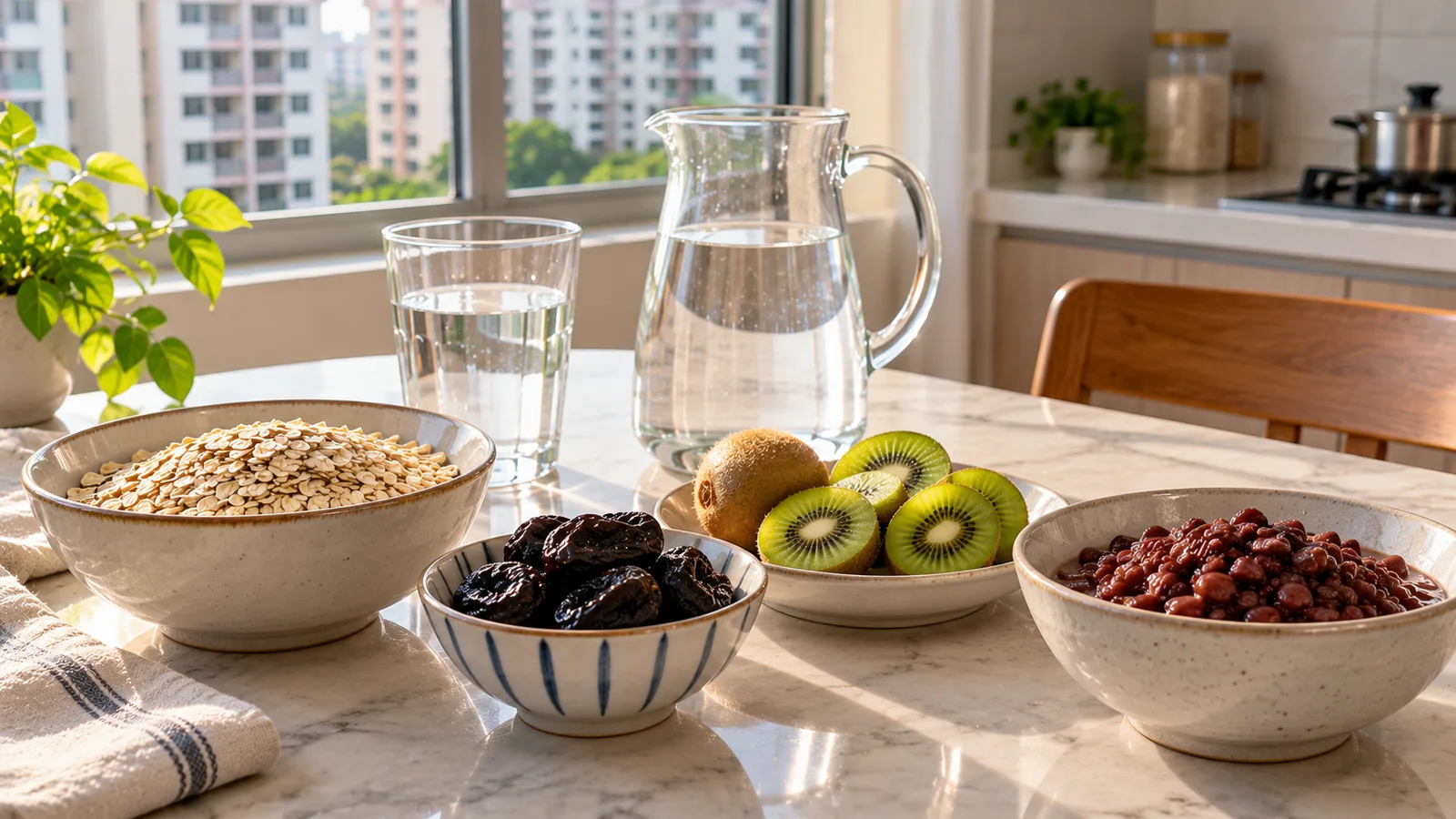
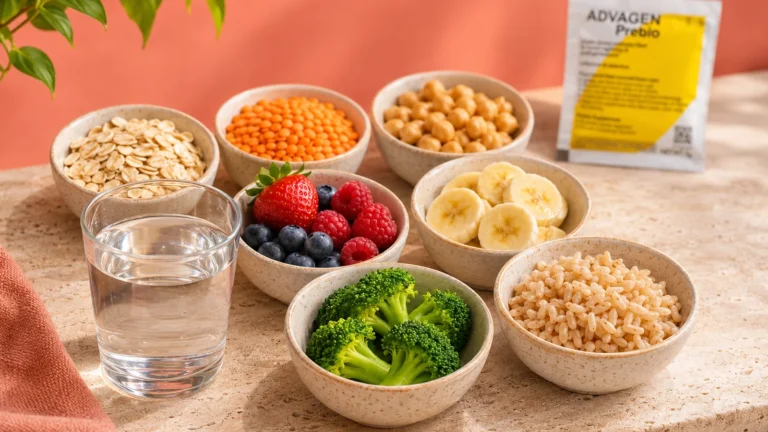
Food is the best place to start. Good sources of soluble fiber in a Singapore diet include oats, barley, beans, peas, apples, oranges, carrots and potatoes. Brown rice, wholemeal bread, nuts and seeds give you mainly insoluble fiber. A plate with both is the right base, before you think about any supplement.
How to add fiber slowly
Go slowly. SingHealth advises raising fiber gradually over two to three weeks. A sudden increase can cause bloating from extra gas. Here is a simple plan you can start this week:
- Check where you are. For three days, note what you eat and roughly how much fiber it gives. Food labels list dietary fiber per serving.
- Add one fiber source at a time. Swap white rice for brown rice at one meal, or add a portion of oats, beans or fruit. Wait a few days before adding the next one.
- Drink with every increase. Have a glass of water, kopi-o kosong or clear soup alongside the extra fiber. Spread your drinks through the day.
- If you use a supplement, start low. Follow the label. Begin with a small amount and build up over two to three weeks.
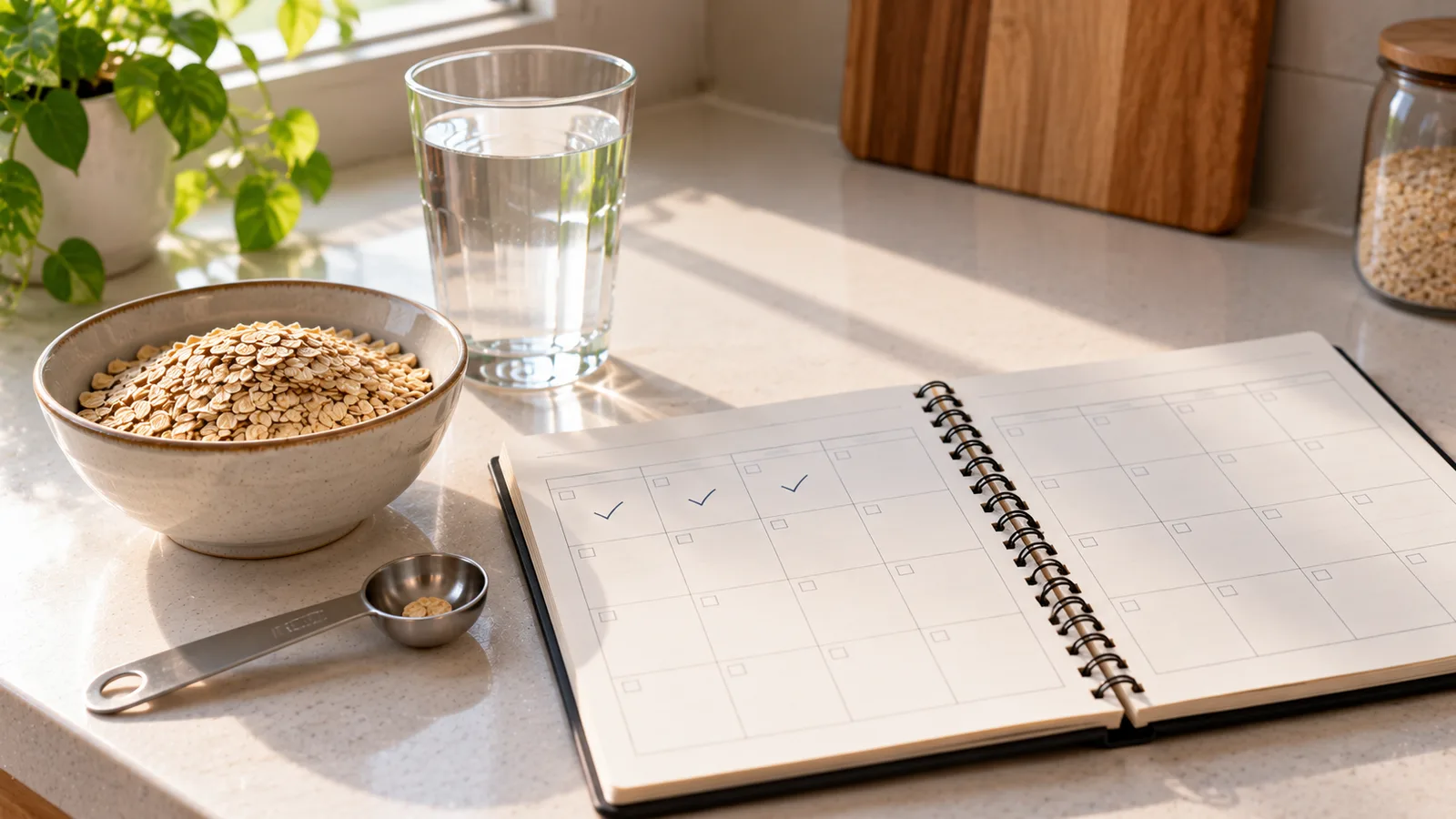
- Give it time. The review above found clearer effects after four weeks or more. Judge a change after about a month, not after three days.
- Keep a simple diary. Note how often you go and whether stools are hard or soft. Our guide to what your stools say about your gut explains what to look for.
Have you recently started eating more protein? That can slow things down too. See why high-protein diets can slow things down.
When fiber causes gas or bloating
Adding fiber can backfire. HealthHub warns that too much fiber too quickly can cause gas, bloating or even constipation. The 2022 review also found more wind in people taking fiber than in the comparison groups. Some gas is common and expected, especially in the first weeks.
Gas forms when bacteria in the large intestine break down carbohydrates that were not digested earlier. Fermentable fibers such as inulin are among them (NIDDK). Our explainer on what happens when gut bacteria ferment fiber covers the details. If you already feel bloated a lot, a slower build-up or a different fiber may suit you better.
Medicines and supplements can play a part too. NIDDK lists iron supplements, and antacids that contain calcium or aluminium, among those that can make constipation worse. If your constipation started with a new medicine, ask your pharmacist before you add anything.
When to see a doctor
Fiber and fluids are self-care steps. They are not a substitute for a check-up. See a doctor if constipation does not settle with self-care, or if you have a family history of colon or rectal cancer. Go promptly to your GP or a polyclinic if constipation comes with any of these (NIDDK):
- blood in your stool or bleeding from the back passage
- constant pain in your abdomen
- being unable to pass gas, or vomiting
- fever or lower back pain
- an unexplained drop in body weight
Age matters too. SingHealth says people above 50 with constipation should have their colon checked, for example by colonoscopy, to rule out colorectal cancer. Whatever your age, a change in your usual bowel pattern that lasts for weeks deserves a doctor’s view. For children, during pregnancy or with a long-term illness, speak to your doctor or pharmacist before changing how much fiber you take.
FAQ
Is prebiotic fiber good for constipation?
It depends on the fiber. “Prebiotic” describes how gut bacteria use a fiber. It does not tell you how well it helps constipation. Inulin-type prebiotic fibers have been studied a great deal. Yet the 2022 review found clear effects for psyllium and pectin. A prebiotic fiber can still help you reach your daily fiber target. Give any fiber about four weeks before you judge it.
How long does fiber take to work?
Give it about four weeks. The 2022 review of 16 trials found that stool frequency improved mainly with treatment lasting at least four weeks, at doses above 10 g a day. Build up over two to three weeks to limit gas. Then hold the new amount steady before you decide whether it is working for you.
Should I drink more water when I take fiber?
Yes. How much you need varies from person to person. But fiber softens stools by holding water, and NIDDK advises drinking water and other liquids to help fiber work better. One 1998 trial found that adults eating 25 g of fiber a day did better when they drank about 2 litres of mineral water daily. Ask a health professional about the right amount for you.
Should I take probiotics or fiber for regularity?
They do different jobs, so it is not a contest. An international expert panel defines probiotics as live microorganisms that give a health benefit when taken in adequate amounts (ISAPP, 2014). Fiber is food for the bacteria already in your gut, and it holds water in stools. Our guide to your resident gut microbiome versus probiotic supplements explains the difference.
Is soluble or insoluble fiber better for constipation?
For hard, dry stools, soluble fiber is usually the better place to start. It holds water and softens stools. Insoluble fiber adds bulk. Most people do well with both from food, plus extra soluble fiber if needed. The fibers with the clearest results in a review of 16 trials, psyllium and pectin, are both soluble.
Where ADVAGEN Prebio fits
Food comes first. A supplement can help you add soluble fiber to your daily diet when meals alone fall short of the 20 g or 26 g target. When you compare products, check the type of fiber and the amount of fiber per serving, not the sachet weight. Then check how it mixes and read the label directions.
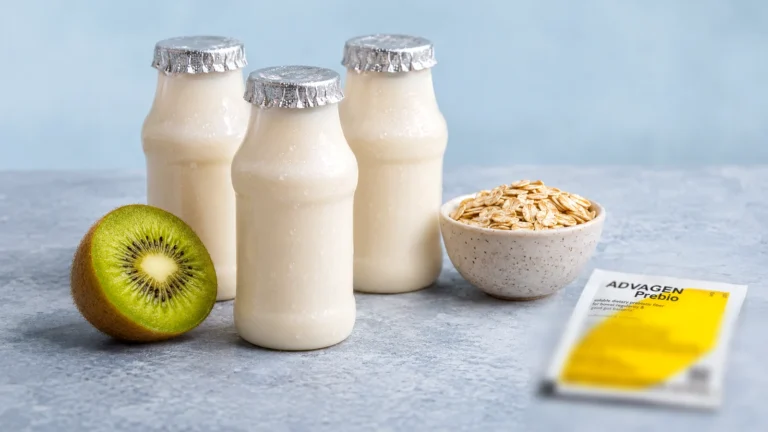
If you want a named soluble fiber that you can add to the drink or food of your choice, ADVAGEN Prebio is made for that. It does not form a gel, and it does not affect the taste or texture of food and drinks. To be clear, Prebio is not psyllium or pectin, the fibers with the clearest results in the review above. It is not a treatment for constipation. Its role is simple: it helps you add soluble fiber to your daily diet.
ADVAGEN Prebio at a glance
- What it is: a plant-based soluble prebiotic fiber supplement. Ingredient: resistant dextrin (soluble prebiotic fiber from corn).
- What it does: helps you add soluble fiber to your daily diet.
- How it mixes: soluble, does not form a gel, and does not affect the taste or texture of food and drinks.
- Label: sugar-free and gluten-free, with no artificial colourings, flavourings or preservatives. Made in a GMP-compliant facility, according to the product page.
- How to take it (product page directions): adults 1 to 4 sachets a day; children ½ to 1 sachet a day; for children under 6, ask a paediatrician first.
- Pack: 30 sachets of 5 g powder, about SGD 0.99 a sachet at today’s shop price.
As with any fiber, start with a small amount, build up gradually and drink enough with it. If you are pregnant, take regular medicine or manage a health condition, check with your doctor or pharmacist before you start.
Topping up your daily fiber?
Where to buy ADVAGEN Prebio
5 g sachetSugar-freeGluten-freeNo gel
SGD 29.60 for 30 sachets SGD 36.00Save 18%
About SGD 0.99 a sachet. Price checked on 19 October 2026; the shop page shows the current price and stock.
Dietary fiber supplement. Not intended to diagnose, treat, cure or prevent any disease.
Read next: how to choose a fiber supplement, or what resistant dextrin is and how much is too much.
References
- van der Schoot A, Drysdale C, Whelan K, et al. (2022). The Effect of Fiber Supplementation on Chronic Constipation in Adults: An Updated Systematic Review and Meta-Analysis of Randomized Controlled Trials. Am J Clin Nutr, 116(4), 953-969. PubMed
- HealthHub Singapore. Boost your health: the essential benefits of dietary fiber. Accessed 19 October 2026. Link
- SingHealth. High fibre diet. Accessed 19 October 2026. Link
- Chang L, Chey WD, Imdad A, et al. (2023). American Gastroenterological Association-American College of Gastroenterology Clinical Practice Guideline: Pharmacological Management of Chronic Idiopathic Constipation. Gastroenterology, 164(7), 1086-1106. PubMed
- National Institute of Diabetes and Digestive and Kidney Diseases (NIDDK). Eating, diet, & nutrition for constipation. Accessed 19 October 2026. Link
- Anti M, Pignataro G, Armuzzi A, et al. (1998). Water supplementation enhances the effect of high-fiber diet on stool frequency and laxative consumption in adult patients with functional constipation. Hepatogastroenterology, 45(21), 727-32. PubMed
- National Institute of Diabetes and Digestive and Kidney Diseases (NIDDK). Gas in the digestive tract. Accessed 19 October 2026. Link
- National Institute of Diabetes and Digestive and Kidney Diseases (NIDDK). Symptoms & causes of constipation. Accessed 19 October 2026. Link
- Hill C, Guarner F, Reid G, et al. (2014). Expert consensus document. The International Scientific Association for Probiotics and Prebiotics consensus statement on the scope and appropriate use of the term probiotic. Nat Rev Gastroenterol Hepatol, 11(8), 506-14. PubMed
This article is general information, not medical advice. ADVAGEN Prebio is a dietary fiber supplement and is not intended to diagnose, treat, cure or prevent any disease. Speak to a doctor or pharmacist about your own health.




Share this article:



[…] next: what fiber is good for constipation, or how to choose a fiber […]
[…] Read next: what resistant dextrin is and how much is too much, or what fiber is good for constipation. […]
[…] Read next: how to choose a fiber supplement, or what fiber is good for constipation. […]
[…] HealthHub suggests about 25 to 30 g of fiber a day and roughly 2 litres of fluid a day (6 to 8 glasses), unless your doctor has told you otherwise. Food comes first: vegetables, fruit, brown rice and wholegrains. The NHS advises increasing fiber gradually, and SGH notes that fiber supplements can take up to a few weeks for the full effect. To compare types, see what fiber is good for constipation. […]
[…] you can read the full label and directions. You can also learn more about ADVAGEN Prebio, or see which fiber types do what. Have a question first? Message us on WhatsApp and we’ll […]
[…] next: what fiber is good for constipation, or what resistant dextrin […]
[…] Prebio is a daily fiber top-up. If you’re properly constipated right now and changes to your food and drinks aren’t helping, the NHS says to speak to a pharmacist. HealthHub lists ispaghula husk among the options a pharmacist can give you, and the NHS suggests trying a bulk-forming laxative first when you buy without a prescription. Read more in what fiber is good for constipation. […]