
Search for a prebiotic supplement for women and you’ll find plenty of pink packaging and big promises. The Singapore health pages we checked don’t set a special “women’s prebiotic”. What they give women is a fiber figure: HealthHub recommends 20 g a day. So the real questions are simple. How far short do your meals fall? And does a product’s label make it easy to close that gap?
Key takeaways
- HealthHub’s figure for women is 20 g of fiber a day. The average Singaporean eats about 13 g.
- “For women” is a marketing label. HealthHub’s fiber advice and HSA’s supplement pages have no women’s prebiotic category. Women need the same fiber basics, with a slightly lower target than men.
- Check six things on the label: fiber per serving, which fiber it is, sugar, how it mixes, the directions and the claims.
- Food comes first. A supplement only tops up what your meals miss.
Why many women in Singapore fall short on fiber
It’s easy to fall short without noticing. SingHealth puts the average Singaporean at about 13 g of fiber a day. That’s well under every official target.
Think about a normal week. Breakfast is kaya toast or a bun on the way to work. Lunch at the desk is chicken rice or noodles. Dinner is whatever’s quick after picking up the kids or a late meeting. Nothing wrong with any of it, but vegetables and wholegrains can easily go missing.
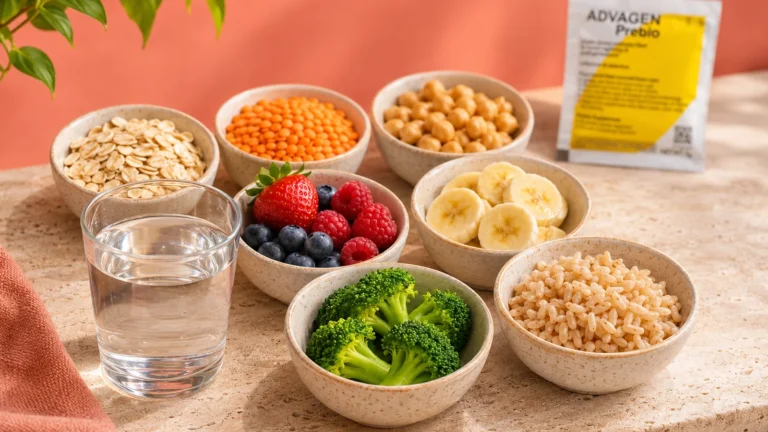
The good news is that hawker food can work in your favour too. HealthHub points to popiah, rojak, tauhu goreng, zi char and nasi padang as good sources of fiber, and suggests asking for more vegetables.
How much fiber does a woman need a day?
HealthHub’s main figure for women is 20 g a day. Other official pages give other numbers, which can be confusing:
| Official page | Daily fiber figure |
|---|---|
| HealthHub fiber page (Health Promotion Board) | 20 g for women, 26 g for men |
| HealthHub constipation page | About 25 to 30 g |
| SingHealth high fibre diet page | 30 g |
We use 20 g in this article because it’s the figure written for women. Go by the higher numbers and the gap just gets bigger. Either way, if you’re eating around 13 g, you’re at least 7 g short most days.
Is there a prebiotic supplement for women specifically?
Not on HealthHub’s fiber pages, SingHealth’s fiber page or HSA’s supplement pages. HealthHub does give women their own fiber figure, but none of these sets a separate prebiotic for women.
A prebiotic, in the definition agreed by an international panel of experts, is “a substrate that is selectively utilized by host microorganisms conferring a health benefit”. In everyday terms, it’s food for the bacteria already living in your gut. Many prebiotics are types of fiber.
A prebiotic is also not a probiotic. Probiotics are live microorganisms; prebiotics are what they feed on.
So a product sold “for women” is mostly packaging. What’s inside, and how much, matters more than who it’s marketed to.
A six-point label checklist
Turn the box around and check these six things. Our general guide on how to choose a fiber supplement goes deeper. This is the quick version for women.
| Check | What to look for | Why it matters |
|---|---|---|
| 1. Fiber per serving | Grams of dietary fiber, not just the sachet weight | Tells you how much of your 20 g daily target one serving covers |
| 2. Which fiber | A named fiber, such as resistant dextrin, PHGG, inulin or psyllium | Different fibers behave differently, so you know what you’re getting |
| 3. Sugar | Sugar-free or low sugar | You’re adding something daily, so sugar adds up |
| 4. How it mixes | Whether it dissolves or forms a gel | Decides if you can stir it into your usual drink or need a separate glass |
| 5. Directions | A clear daily dose and how to take it | Lets you start low and build up |
| 6. Claims | Plain wording, no “cures”, no “HSA-approved” | HSA says supplements aren’t evaluated by HSA before sale, and calls “HSA-approved” a false claim |
One more tip. For food, the NHS says “high fibre” means 6 g or more of fiber per 100 g. For a supplement, compare the grams of fiber per serving on the label.

Gel or no gel: fiber types in plain words
The biggest everyday difference between fiber supplements is texture.
Gel-forming fibers, like psyllium husk, absorb liquid and swell. MedlinePlus says psyllium powder must be mixed with about 240 ml of liquid. That works well for some people, but it means a full glass each time.
Fibers that dissolve without a gel, like resistant dextrin and PHGG, mix into a drink without thickening it. As our comparison of PHGG vs resistant dextrin explains, both are soluble prebiotic fibers that dissolve without turning into a gel.
If your mornings are rushed, the second type is usually easier to keep up. For a wider look, see psyllium vs inulin vs resistant dextrin.
When to check with a doctor or pharmacist first
Some symptoms need a doctor, not a supplement. HealthHub lists these as reasons to see a doctor:
- Blood in your stools, or black or sticky stools
- Very bad stomach pain or cramping
- Fever, nausea or vomiting
- A sudden change in your bowel habits, especially if your weight is also dropping
- A change in the type or texture of your stools
- No appetite
Also check with your doctor or pharmacist before starting if you’re pregnant or breastfeeding, take regular medicines, or have a health condition. HealthHub notes that some supplements, like calcium or iron, can affect your bowels too.
Where ADVAGEN Prebio fits
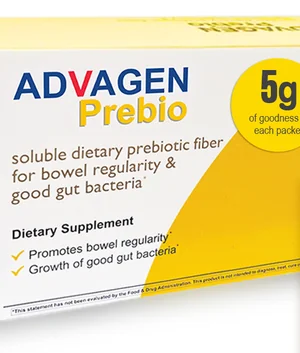
If you’ve worked out your gap and want an easy daily top-up, ADVAGEN Prebio is one option to look at. Here’s how it reads against the checklist:
- Which fiber: resistant dextrin, a plant-based soluble fiber from corn (what resistant dextrin is)
- Fiber per serving: each sachet provides 5 g of dietary fiber
- Sugar: sugar-free and gluten-free, with no artificial colourings, flavourings or preservatives
- How it mixes: soluble, doesn’t form a gel and doesn’t change the taste or texture of your food or drink
- Directions: adults 1 to 4 sachets daily, stirred into a drink of your choice or mixed with food
ADVAGEN Prebio
30 sachets per pack. SGD 29.60 in the official ADVAGEN shop (price checked 18 November 2026).
- See the ADVAGEN Prebio product page for the details
- Want to check something first? Ask us on WhatsApp
How to start and how to take it
Whatever you choose, start small. HealthHub says to introduce fiber gradually, because too much too quickly can bring gas or bloating. SingHealth suggests building up over 2 to 3 weeks.
In practice, take one serving a day for the first week, stirred into your usual morning drink. If that feels fine, add a little more, staying within the label. Keep drinking through the day too: HealthHub suggests at least six to eight cups. Our guides on how much water to drink with fiber and Prebio side effects and how to start have more detail.
FAQ
What is the best prebiotic supplement for women?
There’s no single answer, and the official fiber and supplement pages linked here don’t set a “women’s prebiotic”. Start with your fiber gap against HealthHub’s 20 g a day. Then compare labels: grams of fiber per serving, a named fiber, low or no sugar, how it mixes and clear directions. The right one is the one you’ll actually take every day.
Do I need a prebiotic supplement if I eat well?
Maybe not. If your meals regularly reach around 20 g of fiber, food is already doing the job. A supplement is for the days or weeks when your meals fall short.
Is a prebiotic the same as a probiotic?
No. Probiotics are live microorganisms. Prebiotics are food for the bacteria already in your gut, and many of them are types of fiber.
Are prebiotic supplements approved by HSA?
No. HSA says health supplements don’t need HSA approval and aren’t evaluated before they’re sold in Singapore. A product that says “HSA-approved” is making a false claim, so read the label yourself.
Can I take a fiber supplement while pregnant?
Check with your doctor first. That goes for any supplement during pregnancy or breastfeeding.
References
- HealthHub: more fibre
- HealthHub: constipation
- SingHealth: high fibre diet
- HSA: health supplement regulations
- HSA: health supplement claims
- ISAPP consensus statement on the definition of prebiotics
- NHS: more fibre in your diet
- MedlinePlus: psyllium
- ADVAGEN Prebio: product page
This article is general information, not medical advice. ADVAGEN Prebio is a dietary fibre supplement and is not intended to diagnose, treat, cure or prevent any disease. Speak to a doctor or pharmacist about your own health.
Share this article: