


Breakfast at the kopitiam, lunch at the food court, dinner at the hawker centre near your flat. It’s quick and cheap, but by Thursday you haven’t been to the toilet properly in days.
Here’s the short answer to getting enough fibre when you eat out in Singapore. Order brown rice, extra vegetables and fruit after the meal. On most working days the plate still falls short, so the easiest top-up is a fibre you stir into your kopi, like ADVAGEN Prebio.
Key takeaways
- Singapore’s fibre target is 20 g a day for women and 26 g for men.
- Hawker meals can be better: brown rice, more vegetables, fruit to finish.
- A working-day hawker plate rarely ends up half vegetables, so most of us still fall short.
- Prebio is a taste-free soluble fibre from corn that mixes into any drink and does not form a gel.
Why eating out leaves you short on fibre
You’re not alone in eating out. HealthHub reports that one in three Singaporeans eats out more than seven times a week, and 80% eat at a hawker centre more than once a week. The same page notes that people who usually eat at food centres took in about 200 kcal more than those who seldom eat out.
Calories are one side of it. Fibre is the other. HealthHub sets the Singapore target at 20 g of fibre a day for women and 26 g for men. Its daily recipe: wholegrains on a quarter of your plate, plus two portions each of fruit and vegetables.
Now picture a normal hawker day. Char kway teow, chicken rice, a plate of fried noodles. White rice or plain noodles, a few leaves of cai xin if you’re lucky, and no fruit at all. That’s how the gap builds, one easy meal at a time.
It matters because fibre is what keeps you regular. HealthHub links fibre directly to regular bowel movements. It also says chronic constipation affects one Singaporean in four. If you’ve been wondering whether your own routine is normal, see how often you should poop.
What to order at the hawker centre for more fibre
The good news: the hawker centre has more fibre on offer than you think. You just have to ask for it. These swaps all come from HealthHub’s own hawker and food court guides.
| Where you are | What to ask for |
|---|---|
| Fish soup stall | Fish soup, and ask for more vegetables |
| Indian stall | Chapati instead of prata (it can be made with wholemeal flour), dipped in dhal |
| Herbal soup stall | Ask for brown rice, which HealthHub says helps you feel fuller for longer |
| Noodle stall | Extra vegetables cooked into your noodles; wholegrain noodles if the stall has them |
| Economical rice stall | Choose dishes that have some vegetable in them, and brown rice if it’s there |
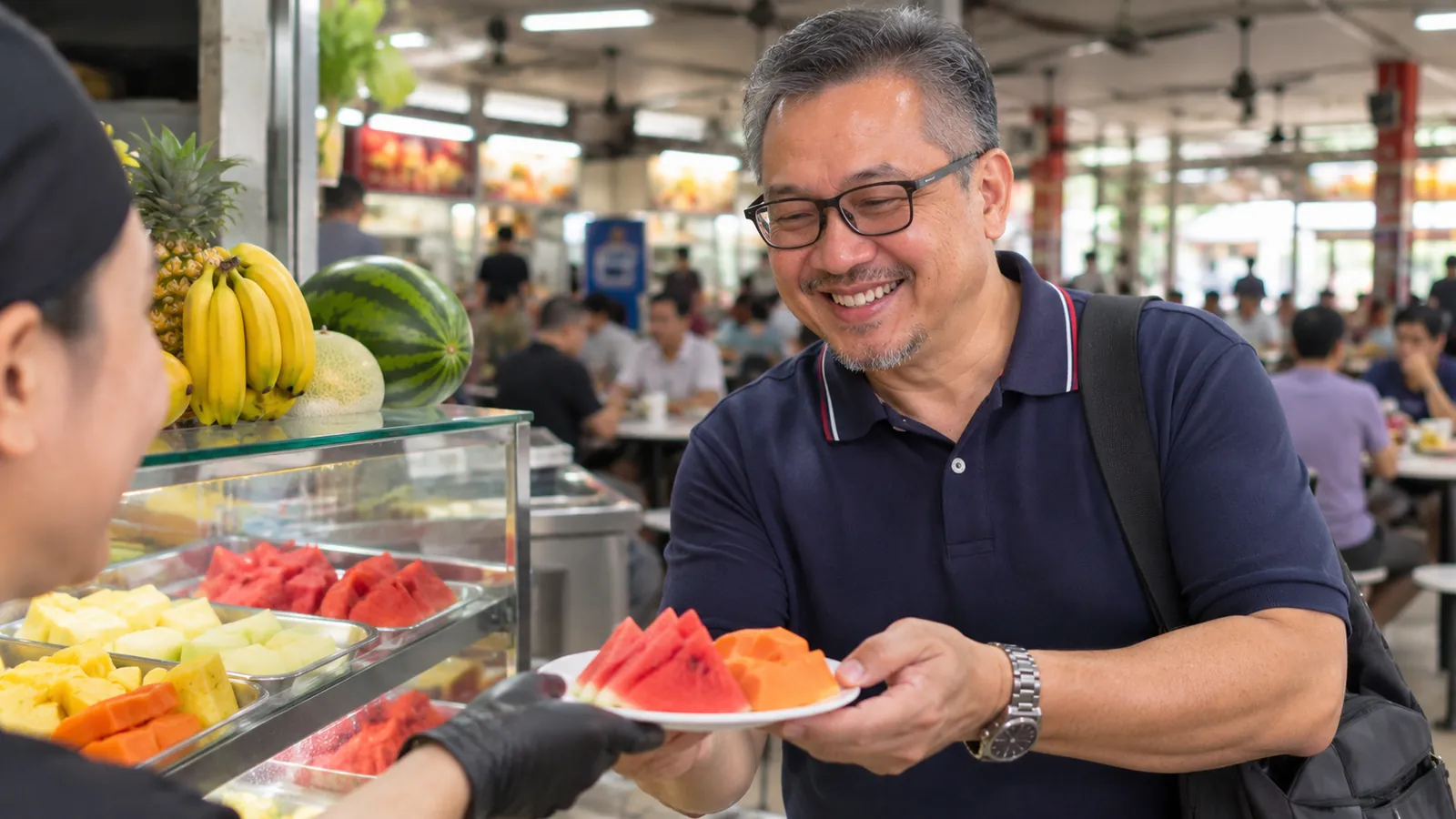
| Fruit stall | A slice of cut fruit to end the meal |
HealthHub’s healthy hawker eats guide sums it up in three moves: swap to brown rice or wholegrain noodles, ask for more vegetables, and aim for two servings of fruit a day.
It is also easier than it used to be. The Health Promotion Board started its Healthier Dining Programme in 2014. Today it covers 300-plus brands and more than 2,600 places to buy healthier food and drinks.
A few more habits help:
- Use the half-plate rule. HealthHub’s food court guide uses My Healthy Plate: half your plate fruit and vegetables, a quarter wholegrains, a quarter meat and others.
- Look for brown rice. HealthHub notes that some hawker stalls serve brown rice, which has more fibre than white rice.
- Finish with fruit. HealthHub points out that most hawker centres serve fresh cut fruit.
- Pack lunch once a week. HealthHub suggests bringing a packed lunch from home, so you decide what goes in.

Is chapati better than prata for fibre?
Often, yes. HealthHub notes that chapati is made without lard, unlike the oilier prata, and that it can be made with wholemeal flour. Its fibre guide also counts two chapatis as one serving of wholegrains, the same as half a bowl of brown rice. So two chapatis with a bowl of dhal count towards your wholegrains for the day. If the stall offers a wholemeal version, pick that one.
Soluble or insoluble: which fibre does a hawker plate miss?
Dietary fibre comes from plants. HealthHub splits it into two kinds, and a typical hawker day tends to run short on both.
- Soluble fibre takes up water as it moves through your gut. HealthHub lists oranges, apples, carrots, potatoes, peas, beans, oats and barley as good sources. It helps soften stools so they pass more easily.
- Insoluble fibre doesn’t take up water. It mostly keeps its shape and gives your stools more size and bulk, which keeps you moving. HealthHub’s sources are brown rice, wholemeal bread, fruit skins, nuts, seeds and cereals.
Look at that list again and compare it with your week. Oats, beans, apples and wholemeal bread rarely show up on a hawker tray. HealthHub also notes that brown rice has more fibre than white rice. So the swaps above do double duty: brown rice adds insoluble fibre, and fruit and vegetables add soluble fibre.
One point that confuses people: HealthHub describes soluble fibre as turning gel-like as it soaks up water. The soluble fibre in ADVAGEN Prebio, resistant dextrin, behaves differently. ADVAGEN says it dissolves and does not form a gel, so your kopi stays the way you like it.
Both kinds count towards the same daily target, and HealthHub’s plan covers both: wholegrains, fruit and vegetables every day, added slowly.
Why your plate still falls short on a working day
Here’s the honest part. HealthHub itself admits it: “Some of us eat at hawker stalls because we have to.”
When you have 30 minutes for lunch, you queue at the shortest line, not the stall with the most greens. The economical rice auntie gives you one scoop of vegetables, not half the plate. Brown rice isn’t at every stall. And the fruit stall is at the other end of the hawker centre.
So most of us end up with some vegetables at lunch, maybe some at dinner, and fruit only on good days. That’s a real improvement. It’s just rarely the two servings of fruit, two of vegetables and a quarter plate of wholegrains, every single day, that HealthHub describes. ADVAGEN makes the same point on its Prebio page: a busy modern life makes a balanced diet hard to keep up.
The easy top-up: ADVAGEN Prebio in your kopi
This is where a fibre supplement earns its place. Not instead of better orders, but on top of them, on the days the plate falls short. ADVAGEN Prebio is built for exactly that kind of day.
What’s inside: resistant dextrin, a plant-based prebiotic fibre made from corn. Each box holds 30 sachets of 5 g powder.
Why it suits people who eat out:
- It goes into the drink you already buy. The label says you can add it to the food or drink of your choice, hot or cold. Your morning kopi, teh, or a cup of water at your desk all work.
- You won’t taste it. ADVAGEN says Prebio does not change the taste or texture of your food or drink. The Prebio FAQs call it “unflavored and taste-free”.
- No gel, no sludge. It’s a soluble fibre that stays liquid in your cup and dissolves almost at once. If you’ve tried a husk-type fibre that thickens in the cup, this is the difference.
- Sugar-free and gluten-free, according to the label.
ADVAGEN’s Prebio site is built around two things: bowel regularity and good gut bacteria. More on how it works in your coffee: fibre supplement in coffee.
Try ADVAGEN Prebio. A box of 30 sachets was SGD 29.60 in the official shop on 8 November 2026.
- Get ADVAGEN Prebio in the official shop
- Ask us on WhatsApp if you’d like to check something first
A simple eating-out fibre routine
- Morning kopi: add one sachet. Stir it in until it dissolves. That’s your fibre top-up done before work. Adults can take 1 to 4 sachets a day, according to the label.
- Lunch: make one swap. Brown rice, more vegetables in your noodles, or a vegetable dish at the economical rice stall. One swap a day is enough to start.
- After lunch or dinner: fruit. Walk past the cut fruit stall on the way out.
- Drink water through the day. HealthHub’s constipation page says to drink more water when you add fibre. See how much water to drink with a fibre supplement.
- Go slowly. HealthHub warns that too much fibre too quickly can bring gas, bloating or constipation, so add it gradually. ADVAGEN notes that side effects of Prebio are mild and transient, such as loose stools and wind. Read what to expect in your first week.
When to see a doctor
A fibre habit is for everyday regularity, not for a medical problem. HealthHub advises seeing a doctor when constipation lasts beyond a week without improving, or worsens.
Also see a doctor if you have fever, vomiting, blood in your stools, black or sticky stools, very bad stomach pain, or a sudden change in bowel habits, especially if your weight drops without you trying.
ADVAGEN also lists abnormalities of the gastrointestinal tract as a reason not to take Prebio, so check with your doctor if you have a known gut condition.
“Can’t I just eat more vegetables?”
Yes, and you should. Every swap in the table above is worth making. If you can reach two servings of fruit and two of vegetables every day from hawker food, you may not need a supplement at all. But if you’re honest about your working week and that’s not happening, a sachet in your kopi is the simplest way to stop falling short while you build better habits. It takes ten seconds and you won’t taste it.
FAQ
How much fibre do I need a day in Singapore?
HealthHub gives the Singapore recommendation as 20 g a day for women and 26 g for men.
What is a high-fibre choice at the hawker centre?
Ask for brown rice or wholegrain noodles, extra vegetables in your noodles or soup, chapati with dhal instead of prata, and cut fruit after the meal. These are all from HealthHub’s hawker guides.
Is fish soup good for fibre?
Fish soup on its own is light. HealthHub suggests asking for more vegetables to make it healthier. Where a stall offers brown rice, HealthHub also suggests swapping it in for white rice.
Can I put a fibre supplement in my kopi?
With Prebio, yes. ADVAGEN says to add the sachet to hot or cold food or drinks and stir until it dissolves. It is taste-free and does not form a gel.
Will extra fibre make me bloated?
It can if you add a lot at once. HealthHub advises adding fibre gradually. For Prebio, ADVAGEN says side effects are mild and transient, such as loose stools and flatulence.
Where can I buy ADVAGEN Prebio?
From the official ADVAGEN shop, where you can read the full label and directions. You can also learn more about ADVAGEN Prebio, or see which fibre types do what. Have a question first? Message us on WhatsApp and we’ll help.
References
- HealthHub: lighter choices at the hawker centre
- HealthHub: eating well at hawker stalls
- HealthHub: healthy hawker eats
- HealthHub: food court lunch tips
- HealthHub: more fibre in your diet
- HealthHub. Constipation
- Health Promotion Board: Healthier Dining Programme
- ADVAGEN Prebio: product page and label
- ADVAGEN Prebio FAQs
This article is general information, not medical advice. ADVAGEN Prebio is a dietary supplement. It is not a medicine for diagnosing, treating, curing or preventing any disease. Speak to a doctor or pharmacist about your own health.
Share this article: