
What Fibre Is Good for Constipation? Types, Water and Tips
What fibre is good for constipation? The fibre with the strongest evidence is a soluble, gel-forming fibre such as psyllium. In a review of 16 trials, it worked best at more than 10 g a day, taken for at least four weeks. Drink enough with it. Add fibre slowly over two to three weeks, because more is not always better.
If you have already tried “more fibre and lots of water” and nothing changed, you are not alone. One person on a constipation forum wrote, “high fiber with lots of water, and a few other diets. Nothing has really helped at all.” That is frustrating. But there is often a simple reason. Which fibre you choose matters. So does how much you take, how long you give it and how much you drink.
Here is the short plan. Choose a fibre with good evidence behind it. Add it slowly. Drink enough with it. Give it about four weeks. And see a doctor if any warning sign appears. Each step is explained below.
Soluble or insoluble: which fibre helps?
Both types can help, but in different ways. Soluble fibre soaks up water as it moves through the gut. That helps make stools softer and easier to pass. Insoluble fibre does not absorb water. It adds size and bulk to stools instead. That is how the Health Promotion Board’s HealthHub describes the two types.
Singapore General Hospital’s high-fibre diet page says much the same. In the gut, fibre draws in water. That makes stools bulkier and softer. So water is part of how fibre works. It is not an optional extra.
For hard, dry stools, a soluble fibre that holds water is usually the better place to start. Insoluble fibre from wholegrains, bran, nuts and fruit skins still belongs in a balanced diet. One catch: “soluble” covers many different fibres, and they do not all behave the same. If you want the basics of each type first, read our guide to soluble and insoluble fibre compared.
Which fibres people use, and which have the best evidence
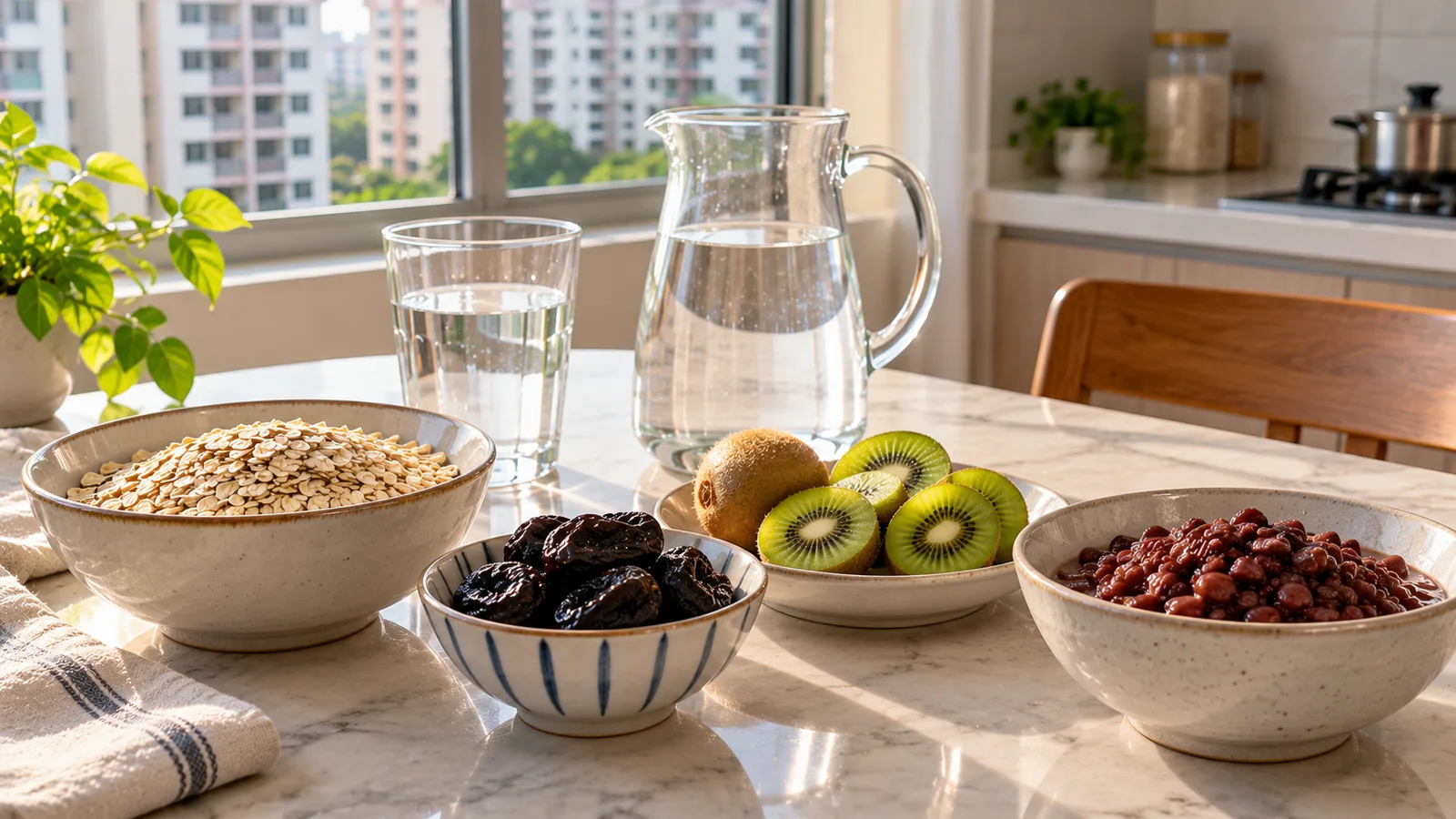
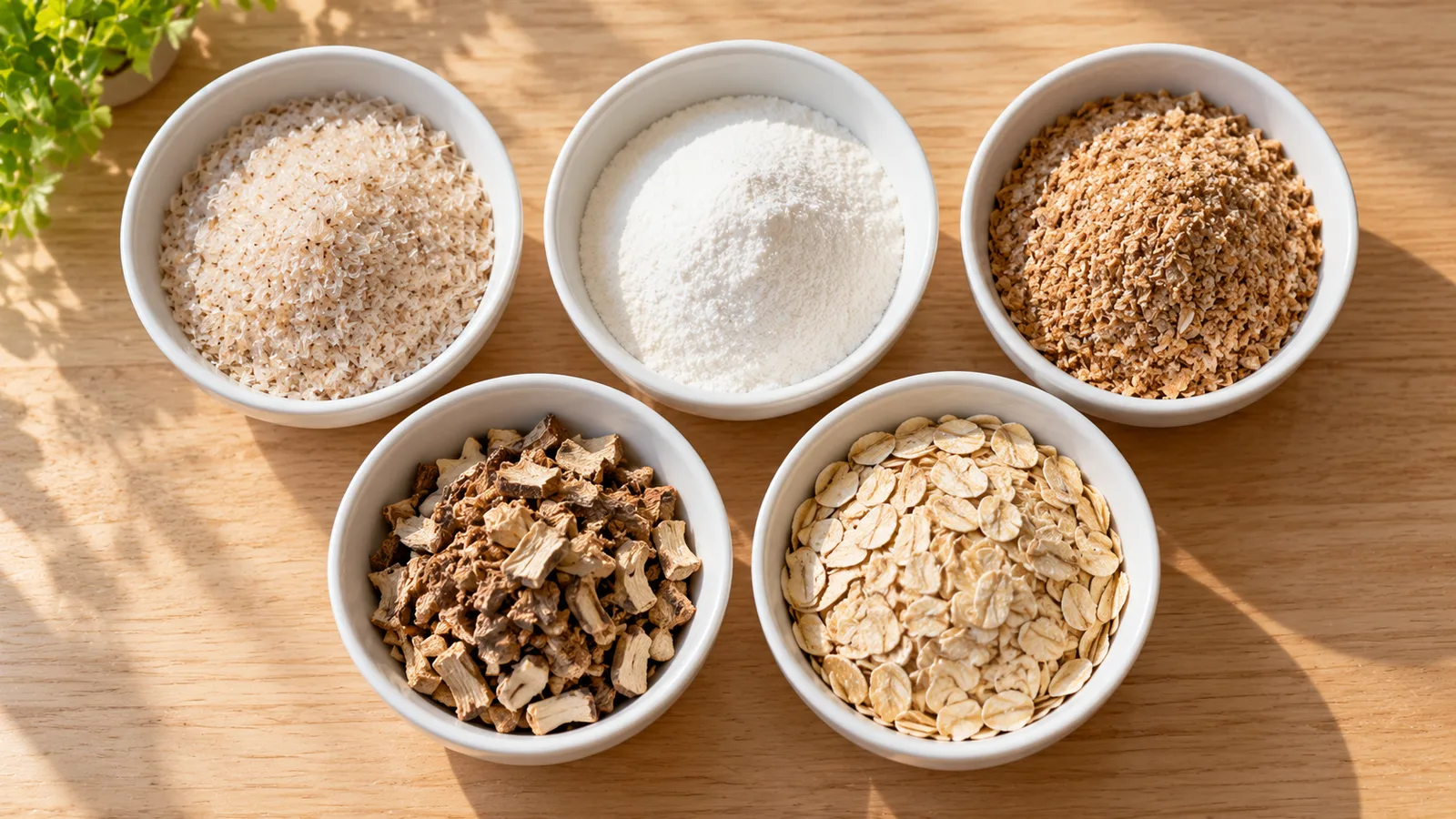
Researchers have tested many fibres for constipation. The list includes psyllium (also called ispaghula), inulin and oligofructose, wheat bran, polydextrose, galacto-oligosaccharides and guar gum. Others have tested whole foods instead, such as prunes, kiwifruit, rye bread and oats.
A useful summary is a 2022 review from King’s College London. It pooled 16 randomised trials with 1,251 adults who had chronic constipation (van der Schoot et al., 2022). Overall, 66% of people taking fibre responded, against 41% in the comparison groups. Psyllium and pectin were the fibres that showed clear effects. The benefit showed up mainly at doses above 10 g a day, and after at least four weeks.
So “any fibre” is not the same as “a fibre with evidence”. If a fibre product does not seem to help after a few days, there are three likely reasons. It may be the wrong fibre. The dose may be too small. Or you may not have given it long enough.
In 2023, the American Gastroenterological Association and the American College of Gastroenterology issued a joint guideline on chronic constipation. It gives fibre a conditional recommendation. Some osmotic laxatives, such as polyethylene glycol, get a strong one (Chang et al., 2023). Fibre is a sensible first step for many people. It is not always the last one.
Why water matters
Fibre softens stools by holding water. So it needs water to work with. The US National Institute of Diabetes and Digestive and Kidney Diseases (NIDDK) advises drinking water and other liquids, such as clear soups. It says this helps fibre work better and makes stools softer (NIDDK).
Oddly, water is rarely the main focus of fibre studies. One trial from 1998 did look at it directly. In that study, 117 adults with chronic constipation all ate about 25 g of fibre a day. Half were asked to drink 2 litres of mineral water a day. The other half drank as they liked. The water group drank about 2.1 litres a day, against 1.1 litres. They had a bigger rise in bowel movements and used fewer laxatives (Anti et al., 1998).
Keep two things in mind. It is a single trial. And it used mineral water, so we cannot tell whether the extra volume or the minerals made the difference. Still, it fits how fibre works.
How much should you drink? There is no single number for everyone. NIDDK suggests asking a health professional, because it depends on your size, health, activity and climate. Singapore’s heat makes this matter more, especially if you sweat at work or exercise. Adding fibre without drinking more is a common reason it seems “not to work”.

Food first: how much fibre you need
In Singapore, HealthHub recommends 20 g of fibre a day for women and 26 g for men. SingHealth notes that the average Singaporean eats about 13 g a day, against a recommended 30 g. Whichever target you use, most of us have a gap to close.
Food is the best place to start. Good sources of soluble fibre in a Singapore diet include oats, barley, beans, peas, apples, oranges, carrots and potatoes. Brown rice, wholemeal bread, nuts and seeds give you mainly insoluble fibre. A plate with both is the right base, before you think about any supplement.
How to add fibre slowly
Go slowly. SingHealth advises raising fibre gradually over two to three weeks. A sudden increase can cause bloating from extra gas. Here is a simple plan you can start this week:
- Check where you are. For three days, note what you eat and roughly how much fibre it gives. Food labels list dietary fibre per serving.
- Add one fibre source at a time. Swap white rice for brown rice at one meal, or add a portion of oats, beans or fruit. Wait a few days before adding the next one.
- Drink with every increase. Have a glass of water, kopi-o kosong or clear soup alongside the extra fibre. Spread your drinks through the day.
- If you use a supplement, start low. Follow the label. Begin with a small amount and build up over two to three weeks.
- Give it time. The review above found clearer effects after four weeks or more. Judge a change after about a month, not after three days.
- Keep a simple diary. Note how often you go and whether stools are hard or soft. Our guide to what your stools say about your gut explains what to look for.
Have you recently started eating more protein? That can slow things down too. See why high-protein diets can slow things down.

When fibre causes gas or bloating
Adding fibre can backfire. HealthHub warns that too much fibre too quickly can cause gas, bloating or even constipation. The 2022 review also found more wind in people taking fibre than in the comparison groups. Some gas is common and expected, especially in the first weeks.
Gas forms when bacteria in the large intestine break down carbohydrates that were not digested earlier. Fermentable fibres such as inulin are among them (NIDDK). Our explainer on what happens when gut bacteria ferment fibre covers the details. If you already feel bloated a lot, a slower build-up or a different fibre may suit you better.
Medicines and supplements can play a part too. NIDDK lists iron supplements, and antacids that contain calcium or aluminium, among those that can make constipation worse. If your constipation started with a new medicine, ask your pharmacist before you add anything.
When to see a doctor
Fibre and fluids are self-care steps. They are not a substitute for a check-up. See a doctor if constipation does not settle with self-care, or if you have a family history of colon or rectal cancer. Go promptly to your GP or a polyclinic if constipation comes with any of these (NIDDK):
- blood in your stool or bleeding from the back passage
- constant pain in your abdomen
- being unable to pass gas, or vomiting
- fever or lower back pain
- an unexplained drop in body weight
Age matters too. SingHealth says people above 50 with constipation should have their colon checked, for example by colonoscopy, to rule out colorectal cancer. Whatever your age, a change in your usual bowel pattern that lasts for weeks deserves a doctor’s view. For children, during pregnancy or with a long-term illness, speak to your doctor or pharmacist before changing how much fibre you take.
FAQ
Is prebiotic fibre good for constipation?
It depends on the fibre. “Prebiotic” describes how gut bacteria use a fibre. It does not tell you how well it helps constipation. Inulin-type prebiotic fibres have been studied a great deal. Yet the 2022 review found clear effects for psyllium and pectin. A prebiotic fibre can still help you reach your daily fibre target. Give any fibre about four weeks before you judge it.
How long does fibre take to work?
Give it about four weeks. The 2022 review of 16 trials found that stool frequency improved mainly with treatment lasting at least four weeks, at doses above 10 g a day. Build up over two to three weeks to limit gas. Then hold the new amount steady before you decide whether it is working for you.
Should I drink more water when I take fibre?
Yes. How much you need varies from person to person. But fibre softens stools by holding water, and NIDDK advises drinking water and other liquids to help fibre work better. One 1998 trial found that adults eating 25 g of fibre a day did better when they drank about 2 litres of mineral water daily. Ask a health professional about the right amount for you.
Should I take probiotics or fibre for regularity?
They do different jobs, so it is not a contest. An international expert panel defines probiotics as live microorganisms that give a health benefit when taken in adequate amounts (ISAPP, 2014). Fibre is food for the bacteria already in your gut, and it holds water in stools. Our guide to your resident gut microbiome versus probiotic supplements explains the difference.
Is soluble or insoluble fibre better for constipation?
For hard, dry stools, soluble fibre is usually the better place to start. It holds water and softens stools. Insoluble fibre adds bulk. Most people do well with both from food, plus extra soluble fibre if needed. The fibres with the clearest results in a review of 16 trials, psyllium and pectin, are both soluble.
Where ADVAGEN Prebio fits
Food comes first. A supplement can help you add soluble fibre to your daily diet when meals alone fall short of the 20 g or 26 g target. When you compare products, check the type of fibre and the amount of fibre per serving, not the sachet weight. Then check how it mixes and read the label directions.
If you want a named soluble fibre that you can add to the drink or food of your choice, ADVAGEN Prebio is made for that. It does not form a gel, and it does not affect the taste or texture of food and drinks. To be clear, Prebio is not psyllium or pectin, the fibres with the clearest results in the review above. It is not a treatment for constipation. Its role is simple: it helps you add soluble fibre to your daily diet.
ADVAGEN Prebio at a glance
- What it is: a plant-based soluble prebiotic fibre supplement. Ingredient: resistant dextrin (soluble prebiotic fibre from corn).
- What it does: helps you add soluble fibre to your daily diet.
- How it mixes: soluble, does not form a gel, and does not affect the taste or texture of food and drinks.
- Label: sugar-free and gluten-free, with no artificial colourings, flavourings or preservatives. Made in a GMP-compliant facility, according to the product page.
- How to take it (product page directions): adults 1 to 4 sachets a day; children ½ to 1 sachet a day; for children under 6, ask a paediatrician first.
- Pack: 30 sachets of 5 g powder, about SGD 0.99 a sachet at today’s shop price.
As with any fibre, start with a small amount, build up gradually and drink enough with it. If you are pregnant, take regular medicine or manage a health condition, check with your doctor or pharmacist before you start.
Topping up your daily fibre?
Where to buy ADVAGEN Prebio
5 g sachetSugar-freeGluten-freeNo gel
SGD 29.60 for 30 sachets SGD 36.00Save 18%
About SGD 0.99 a sachet. Price checked on 19 October 2026; the shop page shows the current price and stock.
Dietary fibre supplement. Not intended to diagnose, treat, cure or prevent any disease.
Read next: how to choose a fibre supplement, or what resistant dextrin is and how much is too much.
References
- van der Schoot A, Drysdale C, Whelan K, et al. (2022). The Effect of Fiber Supplementation on Chronic Constipation in Adults: An Updated Systematic Review and Meta-Analysis of Randomized Controlled Trials. Am J Clin Nutr, 116(4), 953-969. PubMed
- HealthHub Singapore. Boost your health: the essential benefits of dietary fiber. Accessed 19 October 2026. Link
- SingHealth. High fibre diet. Accessed 19 October 2026. Link
- Chang L, Chey WD, Imdad A, et al. (2023). American Gastroenterological Association-American College of Gastroenterology Clinical Practice Guideline: Pharmacological Management of Chronic Idiopathic Constipation. Gastroenterology, 164(7), 1086-1106. PubMed
- National Institute of Diabetes and Digestive and Kidney Diseases (NIDDK). Eating, diet, & nutrition for constipation. Accessed 19 October 2026. Link
- Anti M, Pignataro G, Armuzzi A, et al. (1998). Water supplementation enhances the effect of high-fiber diet on stool frequency and laxative consumption in adult patients with functional constipation. Hepatogastroenterology, 45(21), 727-32. PubMed
- National Institute of Diabetes and Digestive and Kidney Diseases (NIDDK). Gas in the digestive tract. Accessed 19 October 2026. Link
- National Institute of Diabetes and Digestive and Kidney Diseases (NIDDK). Symptoms & causes of constipation. Accessed 19 October 2026. Link
- Hill C, Guarner F, Reid G, et al. (2014). Expert consensus document. The International Scientific Association for Probiotics and Prebiotics consensus statement on the scope and appropriate use of the term probiotic. Nat Rev Gastroenterol Hepatol, 11(8), 506-14. PubMed
This article is general information, not medical advice. ADVAGEN Prebio is a dietary fibre supplement and is not intended to diagnose, treat, cure or prevent any disease. Speak to a doctor or pharmacist about your own health.




Share this article:






[…] next: what fibre is good for constipation, or how to choose a fibre […]
[…] Read next: what resistant dextrin is and how much is too much, or what fibre is good for constipation. […]
[…] Read next: how to choose a fibre supplement, or what fibre is good for constipation. […]